
 site
site contact
 news
newsOh dear what has become of this world?
I miss cars from about 15 years ago. New cars now... I won't go there, something else has happened that I find alarming...
I am currently renting an apartment, previously did own one, but now renting. Anyway, the light in the lounge room failed, so got a ladder to change the light globe. Took off the cover, and was shocked. This is what I saw:
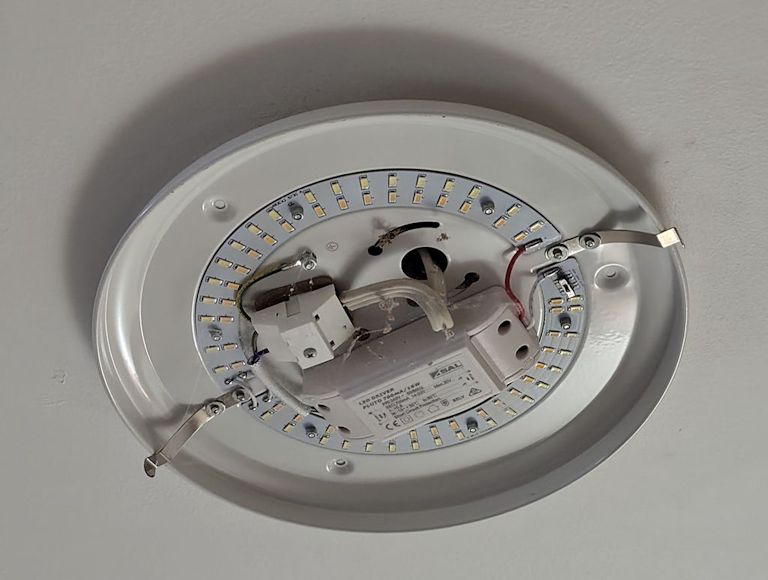
...a complete assembly. Sent an email to the rental agent, she booked an electrician, who came this morning.
Electricians are in high demand here, so I imagine the call-out fee will be high, perhaps around AU$100. Asked Google AI:
In Perth, a typical electrician call-out fee ranges from $80
to $160. This fixed charge covers travel time, fuel, vehicle
costs, and usually the first 15 to 30 minutes of on-site
assessment. It is billed separately from the standard hourly
labor rate, which generally sits between $90 and $150
This is what they fitted, a ROBUS RLUS1824CCT3-01:
...AU$163.46 OK, that is probably the retail price. It is only
guaranteed for 3 years.
There was a time when I would have just gone down to the local shopping centre and bought a new LED globe for about 15 dollars. I am left muttering, oh dear...
EDIT:
I should explain the context of the above post. I was just
recently thinking how cars have become more complex. About 20
years ago, I owned a little Daihatsu 1.0 litre car. It had EFI
(Electronic Fuel Injection) but other than that everything was
mechanical, including wind-up windows. No air-bags either. Loved
that car, incredibly gutsy; due to power-to-weight ratio. That
kind of car would not be legal in Australia now, not as a new car.
Probably wouldn't meet emissions standards either.
Then this electric light event happened, I was once again
reminded of the trend to complexity everywhere; red tape,
nanny-State.
Tags: ethos
"Heartbreaking" decline of Australia
"Heartbreaking" is the word used by Peter Costello, who was Federal Government Treasurer 20 years ago:
Australia has multiple Federal political parties, but the two main ones are Liberal and Labour. The Liberals are kind of like your Republicans in the USA and Labour like the Democrats. The two parties have held office roughly alternating:
Labor (Whitlam): Dec 1972 – Nov 1975
Liberal-National Coalition (Fraser): Nov 1975 – Mar 1983
Labor (Hawke/Keating): Mar 1983 – Mar 1996
Liberal-National Coalition (Howard): Mar 1996 – Dec 2007
Labor (Rudd/Gillard/Rudd): Dec 2007 – Sep 2013
Liberal-National Coalition (Abbott/Turnbull/Morrison): Sep 2013 –
May 2022
Labor (Albanese): May 2022 – present
Peter Costello achieved "debt free day" on April 21, 2006. In 2007, the Labour party got into power, and they started spending big time. National debt climbed.
Costello has blamed Labour, but notice the Liberal party was in power 2013 to 2022, and national debt kept climbing. So it is not just the Labour party to blame, though the Liberal party can partly blame the Covid pandemic.
Now approaching AU$1 trillion, a lot less than you guys in the USA, but we are going down the same path. Bear in mind the population of Australia is only 27.7 million.
Another thing that happened is that house prices have gone through the roof, particularly in the last 6 months. This was warned of by some experts, but the Labour government only applied a bandage over the infected wound.
One really fundamental problem, as I see it, is our "Western democracy". I was reading an article recently, the journalist described it as an "adversarial political system", two or more parties pitched against each other, with elections every 3 years. The parties favour short-term policies that appeal to the people, trying to curry favour with lobby groups, all the while taking pot-shots at the policies of the opposition party.
It is actually quite sad, we unfortunately do not have "10 year" and "20 year" plans that some authoritarian governments are able to implement. Or we do, until the other party gets into power.
I should also mention, my opinion, our politicians are thick. I
can think of some more words.
Tags: ethos
More thoughts on Iran war
I posted this yesterday:
- How will the Iran war playout? — March 14, 2026
To comment any more on this is going down a rabbit hole; should leave it at that. But I am very anxious about our fuel supply situation.
Previous occasions when I have resisted the urge to post a comment, over the last 12 months, have been many. For example, Israel's spin that calling out genocide in Gaza is anti-semitism. The Australian government, both sides of politics except the Greens party, have bought into that narrative.
I'm a member of a men's shed, and one of the old guys there used
to be an officer in the British military. He was based in the West
Bank for awhile, and he told me that the IDF (Israel Defence
Force) treated the Palestinians "brutally".
Israel has a policy of expansion in the West Bank, displacing Palestinians, in their religious right-wing belief in the right to have "greater Israel". Quoting:
https://news.un.org/en/story/2025/06/1164971
Palestinians in the West Bank are being displaced through a
combination of large-scale, intensified military operations,
systematic home demolitions, and rising settler violence, which
together are creating a coercive environment intended to force
residents off their land. Since October 2023, and particularly
through 2025–2026, these actions have resulted in the highest
levels of displacement in the occupied West Bank since 1967.
The IDF has made large swathes of Gaza unlivable, again, what is described by many as systematic genocide.
Given that this has been going on for a long time, that even a retired British Officer remembers mistreatment of Palestinians, is it any wonder that there is a lot of resentment and the rise of military opposition?
I know that I am setting myself up as a target by posting this, but it is only facts. There is another side to the story of course; I have heard people in Israel with a different spin on what is going on, like they are just fighting to survive.
Well, yes, in the early days after the creation of Israel, some arab nations tried to wipe Israel off the map. So, many Israelis have the mindset from that time. So I concede, the situation is very complex.
Now, about Iran...
Yeah, another huge complication.
The USA, roaring in with guns blazing, is pretty typical of the US. Slinking away with "tail between the legs" is also to be expected. But hey, maybe they will pull it off and subjugate Iran. Or:
https://www.facebook.com/photo/?fbid=1525925832228153&set=a.237508854403197

There is a lot of anxiety, even anger, here in Australia ...I
inserted a link in the anger category, but removed it before
uploading this post.
Tags: ethos
How will the Iran war playout?
I have many times in the last 12 months been tempted to make a political post to this blog, but have restrained myself. But, President Trumps actions are having an affect here in Perth, Western Australia; unleaded petroleum has jumped 35%, with likelihood of much pain ahead.
So, still restrained, but want to post something. There are those who say Trump is a narcissist and a pathological liar and a complete idiot, others who say he is actually very clever in his international dealings.
Whatever, I won't reveal what I think about Trump, but the latest situation is having an effect that I cannot ignore. Trump has started a war that is having far reaching consequences. It seems that only Israel is happy about this war.
If global fuel supplies start flowing again in a few weeks, good, but what if this war drags on for months? It will be a disaster for the economies of many countries. Interesting, I am reading comments that it will be good for Russia, and many countries will start buying Russian oil. Australia is heavily dependent on imported oil.
I watched this video, an interview with Larry Johnson:
"IRAN WAR WILL TRIGGER GLOBAL ECONOMIC COLLAPSE + US MILITARY
LYING ABOUT CASUALTIES"
https://www.youtube.com/watch?v=jm2K4WOl_r8
Didn't know anything about him, looked him up on Wikipedia:
https://en.wikipedia.org/wiki/Larry_C._Johnson
...hmmm, he is on the side of Russia in the Ukraine war, if I have read that correctly.
I am planning early next month to drive from Perth, Western
Australia, to South Australia, a distance each way of about
2,500km, but now wondering if it will be possible. Will there be
petrol rationing, will prices be through the
roof?
Tags: ethos
Changan Nevo A06 EV with sodium-ion battery
Yesterday I posted some information about sodium-ion batteries and pondered when we will see them in EVs:
https://bkhome.org/news/202602/when-will-we-see-sodium-ion-batteries-in-evs.html
The first EV to have sodium-ion has been announced, the Changan Nevo A06:
"Changan and CATL unveil world’s first mass-produced sodium-ion
passenger EV"
https://carnewschina.com/2026/02/05/changan-and-catl-unveil-worlds-first-mass-produced-sodium-ion-passenger-ev/
...it is being promoted as exceptional in cold climates. Tests have been conducted at Yakeshi, in northern China.
I don't have the link, but there was recently a test of several different EVs somewhere very cold in northern Europe. They were driven until they stopped, and the degradation in range reported. I think the degradation was between 20 and 45%. Ah, found it, it was 24 EVs, and tested in Norway:
"Real-World Range: 24 Electric Vehicles Tested in the Coldest
Test on Record"
https://www.youtube.com/watch?v=XUDJRF8Kmh4&t=502s
Some points about that degradation: it is not permanent, if temperature rises battery capacity will come up. However, charging a very cold lithium battery can permanently damage it. More information here:
"Understanding Low-Temperature Behavior of LiFePO4 Batteries"
https://www.large-battery.com/blog/low-temperature-performance-lifepo4-batteries/
Quoting, about cell damage:
Capacity loss reached 25% after just 40 cycles at a 0.5C charge rate. Even at 0°C, a single charge cycle at 1C caused a 3.6% irreversible capacity loss in a 7.5 Ah cell.
...1C charge rate is very low. Fast charging would be a disaster.
In the Norway test, the reason that some EVs had better range, would probably be due to the thermal management, warming up the batteries.
I can see EVs with sodium-ion batteries becoming very popular in northern Europe, Russia and Canada.
Low-temperature performance of sodium-ion batteries is great, but there are other advantages over lithium. One of those is safety. Quoting from the link at top of this post:
The Naxtra battery exceeds national standards. Under extreme abuse conditions, including multi-directional extrusion, electric drill penetration, and complete sawing while fully charged, the battery exhibited no smoke, no sensation, no fire, and no explosion, remarkably continuing to discharge normally even after being sawn through.
That mention of "national standards"; the Chinese authorities have raised the bar for battery safety. I don't recall when it comes into effect, early this year I think, all new EVs must have batteries that meet this standard, and CATL's Naxtra sodium-ion battery has been accredited to meet the standard.
Going the other way, high temperatures over 40 degrees C, it is a
similar scenario. So in hot climates there might be a market for
sodium-ion also.
Fascinating!
Tags: ethos
A new age of misinformation, augmented by AI
I posted recently that ordered a Bluetti AC70 power box:
https://bkhome.org/news/202601/bluetti-ac70-power-box.html
It has an XT60 socket, to which a solar panel can be connected. I couldn't see in the AC70 documentation whether it is a female or male socket, so I asked Google AI:
The BLUETTI AC70 input charging socket is a female XT60 port,
which requires a male XT60 connector on the charging cable
(solar or car) to plug in. It is designed to receive power from
cables that feature a male-ended XT60 plug.
AC70 Port: Female XT60
Required Cable End: Male XT60
For direct solar connection, you will typically need a
PV-to-XT60 cable, where the XT60 end is male.
...Google AI told me this with certainty, so I thought good, and ordered an adaptor cable, "XT60 M to 50A", for my extension cable that has Anderson 50A plugs on both ends:
https://www.aliexpress.com/item/1005009437595177.html

After ordering, did a bit more reading and also found a photo
showing rubber flap over the XT60 socket lifted, and hey, it is a
male socket. Therefore, the adaptor cable needs to be an XT60
female, the opposite of what Google AI told me. The above photo is
the XT60 female.
I immediately cancelled the order, and ordered the correct
adaptor. The AC70 arrived today, and confirmed my choice is
correct.
Tags: ethos
Report low noise on China roads
I was quite amused by this; "The Australian" media posting something positive about China! The Australian is part of News Corp, which is owned by Rupert Murdoch, and well known for extreme right-wing viewpoint. This is the post:
"How China crushed Beijing’s crazy traffic noise"
https://www.youtube.com/watch?v=hXA8r9SZatc
The surprise in comments, how come they aren't slagging off on China as usual, actually posting something positive?
Well, yes and no, I think; the journalist does have to be careful. For a start, the guy mentions one million complaints about noise levels. What he doesn't say is how those complaints came about. Obviously, there has to be some mechanism for citizens to contribute opinions to the government. Asking Google AI "How does democracy work in China":
Democracy in China operates under a model termed
"whole-process people's democracy," which integrates electoral,
consultative, and management processes under the strict,
singular leadership of the Communist Party of China (CPC).
Unlike Western, multi-party systems, it prioritizes
consensus-building, policy implementation, and socioeconomic
outcomes over competitive, pluralistic elections.
Key aspects of how this system works include:
Whole-Process People's Democracy: Described as a
blend of electoral and consultative democracy, this model claims
to ensure public participation in all stages of governance,
including legislation and decision-making.
Structure of Governance: The National People's
Congress (NPC) is the highest organ of state power, with members
indirectly elected by lower-level congresses. Local people's
congresses at the township and county levels are directly
elected, but all candidates are subject to CPC oversight.
Consultative Approach: The Chinese People's
Political Consultative Conference (CPPCC) works alongside the
NPC to provide policy advice and facilitate dialogue, involving
representatives from different sectors of society.
Party Leadership: The CPC maintains a monopoly on
political power, with all political opposition illegal. All
elections are held under the guidance of the party.
Focus on Performance: This model claims to be
effective by focusing on practical, long-term improvements in
people's lives and social stability.
The system is designed to avoid the competition seen in
Western models, aiming instead for efficiency and representation
through "consultation" before, during, and after
decision-making.
I have read about the mechanism before, whereby ordinary people can contribute. I presume it is the "NPC" that accumulated the 1 million complaints about noise. The YouTube channel "Gerry's Take on China" has more information about that process.
Another comment in the video, that the pollution is exported to the countryside, and the comment about lots of coal-fired power stations being built. Yes, true, but...
China has enormous energy requirements, and coal-fired power stations are still being built; however, it has reached a plateau. The Chinese government is planning for clean power generation, and solar, wind, thermal, nuclear and hydro generation is ramping up faster than coal. With the long term goal that coal generation will drop and eventually die.
The report did not even mention nuclear. Google AI:
As of early 2026, China has around 59 operating nuclear reactors, placing it second only to the United States, with a significant number (around 28-38) also under construction and many more planned, making it the world's fastest-growing nuclear power market. The country is rapidly expanding its fleet, aiming to significantly boost its nuclear capacity in the coming years to meet rising energy demands, and is a leader in building new reactors and developing advanced technologies like Small Modular Reactors (SMRs)
...massive expansion. Also there is a thorium nuclear reactor,
and there are likely to be many of these in the future -- these
are very safe reactors, with radioactive byproducts that decay
quickly.
Whatever you might think of the Chinese government, one advantage
is that they can plan long-term.
Tags: ethos