
 site
site contact
 news
newsEIS, OIS, gimbal, or post-process video
In my YouTube "Nomad" series, I record a lot of videos while walking. When I purchased my Moto G75, the OIS (Optical Image Stabilization) feature was one of the deciding factors. There is some jerkiness when walking, and I suppose the OIS helps; however, when panning, which I do a lot, there is a jerkiness that is actually caused by the OIS.
I asked Google about this:
Panning shots: Sometimes internal stabilization fights a
smooth pan and creates a jerky snap at the end of the movement.
Well, no, not at the end of the pan, I get it 2 or 3 times during a large pan. Google AI also stated this:
Using a tripod: Keeping stabilization on while the camera is completely still can cause small, unwanted floating or jumping motions. Turn it off for tripod shots.
I have been experimenting with video post-processing stabilization apps, but they don't make the videos better.
Watching YouTube videos, it seems that top-brand action cameras can track an object, such as a face, and record very un-jerky videos. Or, use a 3-axis gimbal, either a camera with integrated gimbal, or one to which a phone can be attached. Latter example:
https://www.jbhifi.com.au/products/zero-x-3-axis-gimbal-with-power-bank

...main problem is they are large. When I travel, want recording
to be as discrete as possible.
Or, combined camera and gimbal, such as the DJI Osmo Pocket:
https://www.jbhifi.com.au/products/dji-osmo-pocket-3-4k-3-axis-gimbal-camera-combo
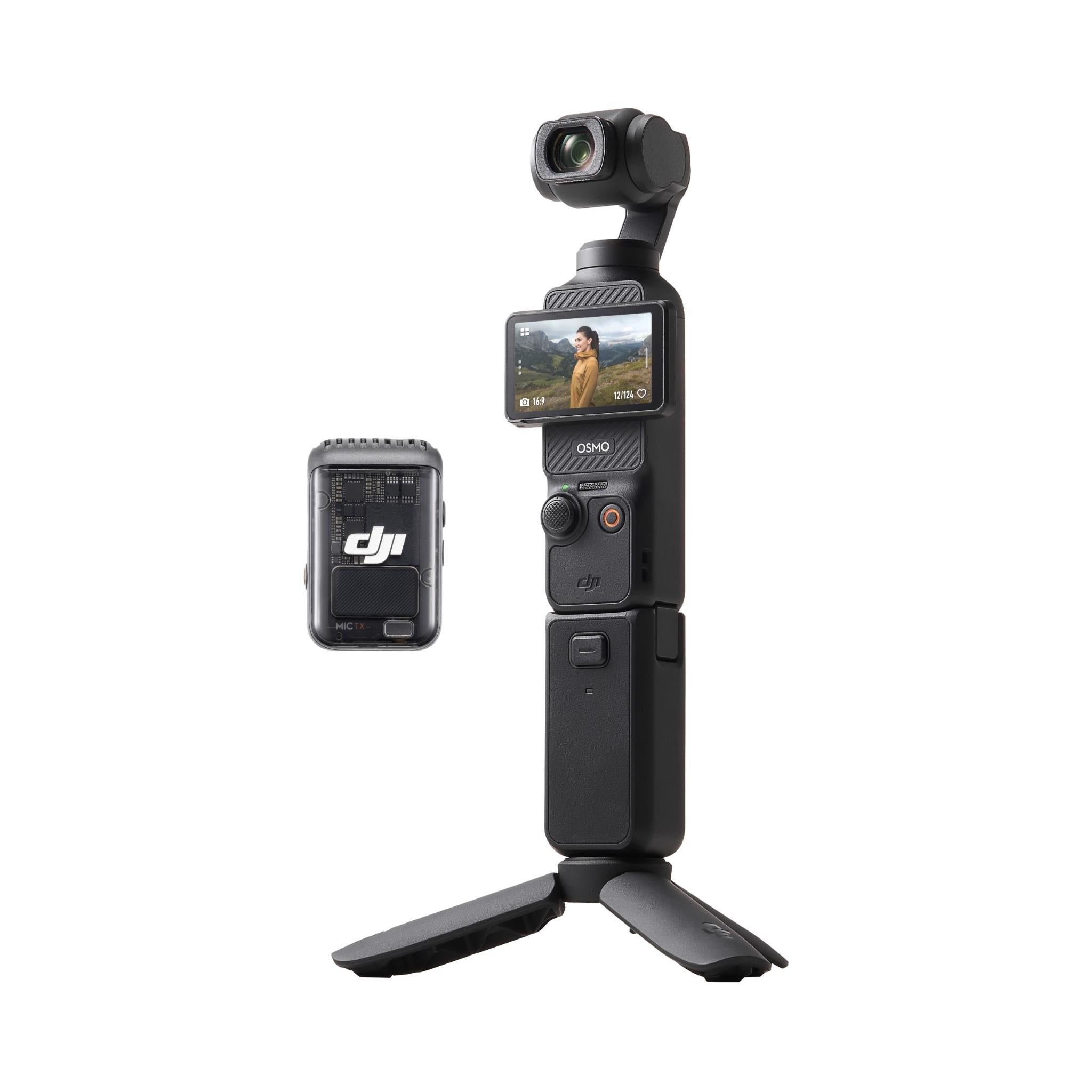
...AU$789!!!
No, not ready to throw money at something like that. Not yet anyway. Still one more thing to try with my phone; record with OIS turned off, then post-process. Will give that a go tomorrow.
To follow the progress, here is my "Nomad" video series:
https://www.youtube.com/@meanderinglight/videos
Tags: nomad
Phone signal in tent
Ha ha, this is funny. I have been camping here for two weeks, at
a campground on the south coast of Western Australia, and had to
walk about 5 minutes to the beach to get a phone signal.
Wasn't getting a signal in my tent; however, today discovered if raise my phone, and get it into just the right spot, there is a weak 4G signal:
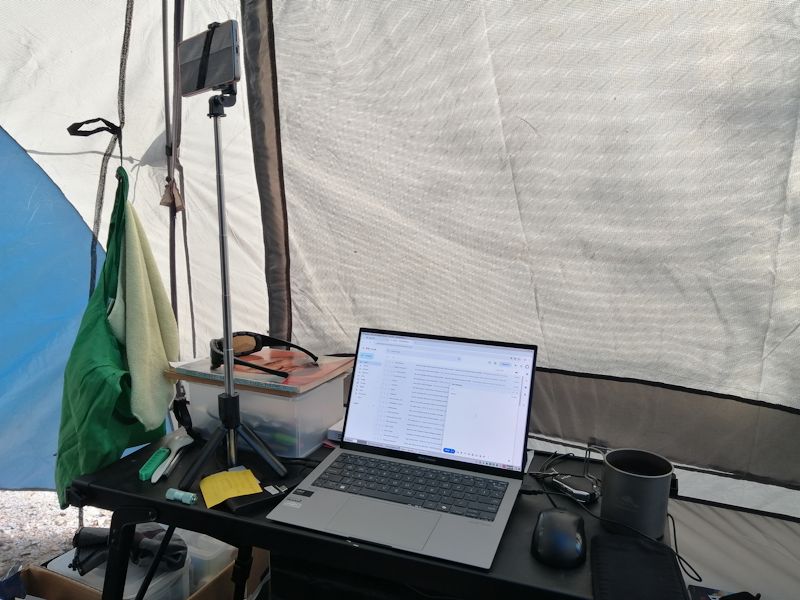
It is weak, some websites timeout, but can do basic browsing with
phone a wifi hotspot; gmail and forum access ok. The signal may be
dependent on the weather, we shall see.
Tags: nomad
YouTube Nomad-series adventure underway
See parts 2, 3 and 4, checking out an old house and inexpensive Shire-run caravan parks:
https://www.youtube.com/@meanderinglight/videos
Right now, I'm at Ravensthorpe, at a free RV overnight stop. Toilet across the road, petrol station that sells food. Nice little place to stopover, maximum allowed 48 hours.
It is not permitted to erect a tent here; anyway, for one night I
will just sleep in the car.
So, how do I use my laptop in this tiny little Kia Picanto hatchback? Did consider a tray to hook onto the steering wheel; however, not enough room. Instead, the plywood from the folding table serves as a nice surface, placed on the passenger-side:

...have to twist to the side to use it, but OK.
As my videos are mostly going to be taken while walking, have seen the limitations of the phones. They have EIS (Electronic Image Stabilization), but can see its limitations. Seriously considering buying a DJI Osmo Pocket4, with 3-axis gimbal:
https://www.jbhifi.com.au/products/dji-osmo-pocket-4-standard-combo
...well, that will have to wait, as booked in at the campsite for 4 weeks. Maybe after that will locate the closest JB-HiFi store.
As on-the-go for the last few days, have ignored EasyOS and the forum; however, once settled at the campsite on the coast, will get back to it.
Tags: nomad
Simple solution to boil water while camping
Fine-tuning the gear for upcoming "grey nomad" adventures. I have an alcohol stove, also a small gas cylinder with screw-on burner; these are for "one pot" cooking, probably twice a day.
But also want to make two cups of tea and one coffee per day, and it might turn out to be a chore to boil water 3 times per day in addition to cooking 2 meals. Had a think about it, and decided why not purchase a tiny electric kettle.
This is my lithium power box:
https://bkhome.org/news/202601/bluetti-ac70-power-box.html
It has a 1,000W sine-wave inverter, rated at 2,000W surge. Little
mains-powered portable kettles that draw only 300W are available.
There are 12V kettles, that run off the cigarette-lighter socket in a car; however, I think that they overly stress the current limit of the fuse, socket and cabling in the car.
Checked them out; those 12V kettles. To limit current draw to
something safe, they are very low power. Looked at one, just 96W
...how long is the user expected to wait for the water to boil?!
Found another that boils fast, but draws 31.5 amps!!!!
I bought this, Balabulala 500ml 240V 300W:
https://www.ebay.com.au/itm/257394510124
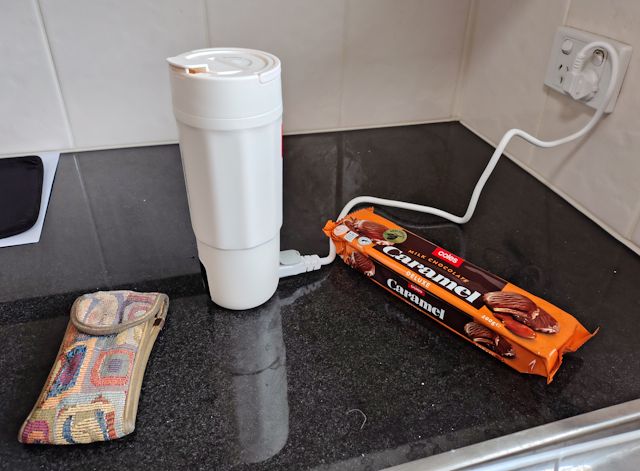
...the phone wide-angle lens distorts the image somewhat, giving the false impression that the diameter tapers out toward the top.
I was going to buy two kettles, one other type for a comparison report. This one, Focustar brand, 400ml 300W:
https://www.amazon.com.au/Focustar-Portable-Electric-Temperature-Protection/dp/B0BFHYHY1L/?th=1
...not from those particular vendors. I ordered it on eBay, then canceled the order after discovering their misleading postage details.
A thumbs-up to the Balabulala vendor; they shipped it by
Australia Post tracked parcel, and it arrived 6 days after
ordering, shipped from the other side of Australia.
The Focustar is considerably cheaper, but reviews are very mixed.
The 400ml for example; some reviewers say that you should put in
less than 300ml -- one reviewer said 275ml -- if intend to bring
it to the boil. Also, there is no digital temperature display.
The Balabulala does hold 500ml, with a marking at 400ml; no more than 400ml must be put in if the water is to be boiled. I don't have a measuring jug, but do have a Toaks 450ml titanium mug, and was able to judge approximately that the Balabulala claimed capacity is correct.
400ml took about 6 minutes to boil. So, three cups of tea and coffee per day, that is about 30Wh per cup, 90Wh per day. The Bluetti battery is rated at 768Wh, so happy with that.
Bearing in mind though, will be running a 12V fridge, LED lights and laptop. Solar panel puts out about 150W, so should be OK.
An interesting point to note: the Balabulala has a diameter of
80mm, same as the Focustar, and is 215mm high, 15mm higher than
the Focustar -- which is to be expected, given its larger water
capacity. But the Balabulala is still pleasingly small, easy to
pack away somewhere in the car.
Tags: nomad
Printing while tent-camping
My life is taking a radical new direction; soon will be semi-permanently a "grey nomad'. Not in a RV though; just car and tent.
Will be leaving my apartment, and want only to keep what will fit in the car. This is radical; heaps of gear and furniture has already gone. Advertising things, getting rid of it day by day.
Currently reduced to two laptops and one desktop system. The latter includes a Brother HL2040 laser printer and UPS. Decided to give it to the Lion's Club. They give computers to poor people, both in Australia and third-world countries.
But, still want to be able to print sometimes. There are places to go, such as OfficeWorks, that offer low cost printing. But, still, would be nice to have my own printer.
There are really tiny A4 thermal printers, and cheap, such as this one at Kmart; however, they require thermal paper, that fades. One requirement is that I will be doing online booking at some campsites that require the booking confirmation to be left on the car dashboard so the park ranger can see it. A printout on thermal paper, in sunlight, will very quickly turn completely black. Even out of the light, in a warm car, will quickly turn black. I read that even keeping the printout in a relatively cool house, it will only last 6 months.
There is another possibility, what is called a "thermal transfer" printer, that has a ribbon. These print onto normal paper, and the result is permanent. They are very small. So, have ordered one, a Phomemo P831:
https://www.ebay.com.au/itm/126202984702?var=427216256520

A good thing about this printer, is there is a Linux driver:
https://pages.phomemo.com/#/p831
There is one downside; the ribbon is only good for about 45 pages. I bought two spare ribbons, at AU$10 each; that works out to 22 cents (15 US cents) per page. That's OK. I don't do much printing, maybe 20 - 30 pages per year.
Another thing, while on the road; although I don't use optical media at all, not for the last several years, there may still be a need to test with EasyOS. Neither of my laptops have builtin cd/dvd drives, so ordered this:
https://www.ebay.com.au/itm/397758162064

So, in the tent will have a small collection of computer
hardware, enough to continue with EasyOS development.
Tags: nomad
Fuel economy across the Nullarbor Plain
The Nullarbor Plain is a large expanse of flat, in some places treeless, limestone land, that the Eyre Highway traverses connecting west and east sides of Australia. I have just got back from a drive across, Perth to Coober Pedy, a round trip over 5,000km, as reported earlier today:
"Naughty Kia?"
https://bkhome.org/news/202604/naughty-kia.html
...the Kia Picanto actual fuel consumption was a bit uncertain, depending whether we believe Kia or the petrol pumps. I'll say it is somewhere in the middle, about 5.0 litres/100km (47 mpg).
I had a chat with a guy at one of the roadhouses on the Nullarbor, driving a motorhome. This is a 4wd with fat tyres. He said driving at the 110 km/h limit on the Eyre Highway, he was getting 13 litres/100km, but when driving in the Northern Territory, where there roads have no speed limit, he was pushing 16 litres/100km (14.7 mpg) ...yikes!
Fuel consumption is a huge issue right now, as Australia imports
90%. It has become expensive, often about 50% more than before the
iran war. It is going to force up the cost of everything.
Chatted with a guy on a motorcycle, a Himalayan 450cc; he said
that he was getting 3.5 to 4 litres/100km. His bike is air-cooled,
whereas the latest models are water-cooled. I wondered whether the
water-cooled bikes would have better economy, and it does seem a
little bit. For example, this guy reports about 3 L/100km:
"Big Al’s Bike Review 2024 Royal Enfield Himalayan 450"
https://www.ulyssesstgeorgesutherland.com.au/bike-review-2024-royal-enfield-himalayan-450/
This guy is reporting 2.8 to 3.0 L/100km:
"Royal Enfield Himalayan 450 Review 2025: The Ultimate Budget
Adventure Bike?"
https://www.reallybigbikeride.com/royal-enfield-himalayan-450-review/

Interesting also, in total I passed five bicycles, four riding east, one west, and one guy walking. oh yeah, on the return journey, passed one guy jogging! -- he had a trolley behind him, attached to his waist belt. His has a single pole to hook onto the waist, but have seen others with two poles, like this one:

Ha ha, there's even a Facebook group for these trekking trailers:
https://www.facebook.com/groups/wheelie.radical
...looks good, getting the weight off the back!
Tags: nomad
Naughty Kia?
I have just got back from a very long drive, from Perth in Western Australia to Coober Pedy in South Australia. it was partly sightseeing, but also, I had seen a news item that Coober Pedy and Andamooka have the cheapest houses in Australia. Was contemplating moving there.
There is an earlier post showing the fuel consumption of my Kia Picanto 1.2 litre manual car:
"Camping in-car sleeping"
https://bkhome.org/news/202603/camping-in-car-sleeping.html
...4.8 litres/100km.
Wondered whether this is true, so on the trip to Coober Pedy,
recorded the amount of fuel (unleaded 91-octane), price, and
distance at every bowser. Just checked on that word "bowser"; that
is a common word used for the fuel-dispenser in Australia -- that
would be "gas pump" in the USA. I think in Britain it is "petrol
pump".
Did calculations over most of the journey and between segments of the journey, and got consumption figures between 5.27 and 5.29 litres/100km ("liters" in American English).
Whereas, the display in the car, a short time after starting the journey dropped to 4.6 litres/100km and stayed there the entire journey. Not quite, there was a short segment where I pushed the car to 110 - 116 km/h and consumption indicated 4.7, and when I eased off to the usual 95 - 110 it dropped back to 4.6.
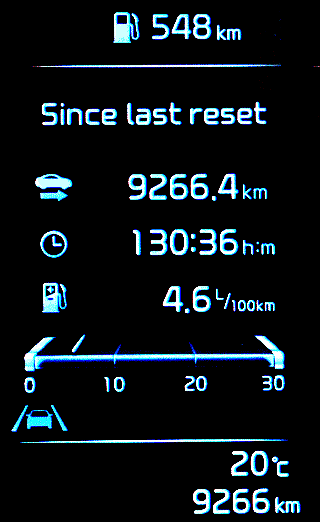
...snapshot taken near end of journey.
Significant difference; which is correct?
What could account for the difference is the bowsers
under-pouring. There are inspectors who check metering and impose
a fine if incorrect. A couple of reports are that 1 in 20 bowsers
were found to be under-pouring in 2019:
"Petrol bowser audit reveals under-pouring, Government authority
issues fines"
https://www.abc.net.au/news/2019-12-17/australian-petrol-bowsers-caught-under-pouring-by-auditors/11804344
Then another study in 2026, the under-pouring has grown to 1 in 10:
"1 in 10 Petrol Stations are Short-Pouring Aussies, Audit
Reveals"
https://manofmany.com/auto/cars/1-in-10-petrol-stations-short-pouring-australians
...and the fines have been massively increased.
Hmmm, I wonder how often those fuel bowsers out in the middle of
nowhere, the Nullarbour Plain, get checked?
In summary, it is possible that the Kia screen readout of 4.6 litres/100km (51.1 mpg) is correct. However, I doubt it, as Kia's own publicity states consumption to be no less than 5.0. See also this independent table, a figure of 5.0, which also shows how much better the manual is compared with the automatic:
https://www.carsguide.com.au/kia/picanto/engine
So 4.6 is likely wrong, meaning that Kia is cheating, showing
better fuel economy than actual. That's how it seems
anyway.
Tags: nomad